
Surgery vs. Physiotherapy: How to Know When Surgery Is Needed

Considering Knee Replacement? Understand the Tests, Alternatives & Lifestyle Goals
September 5, 2026
Why Is Your Knee Pain Worse at Night? Causes, Habits & Treatment Options
September 25, 2026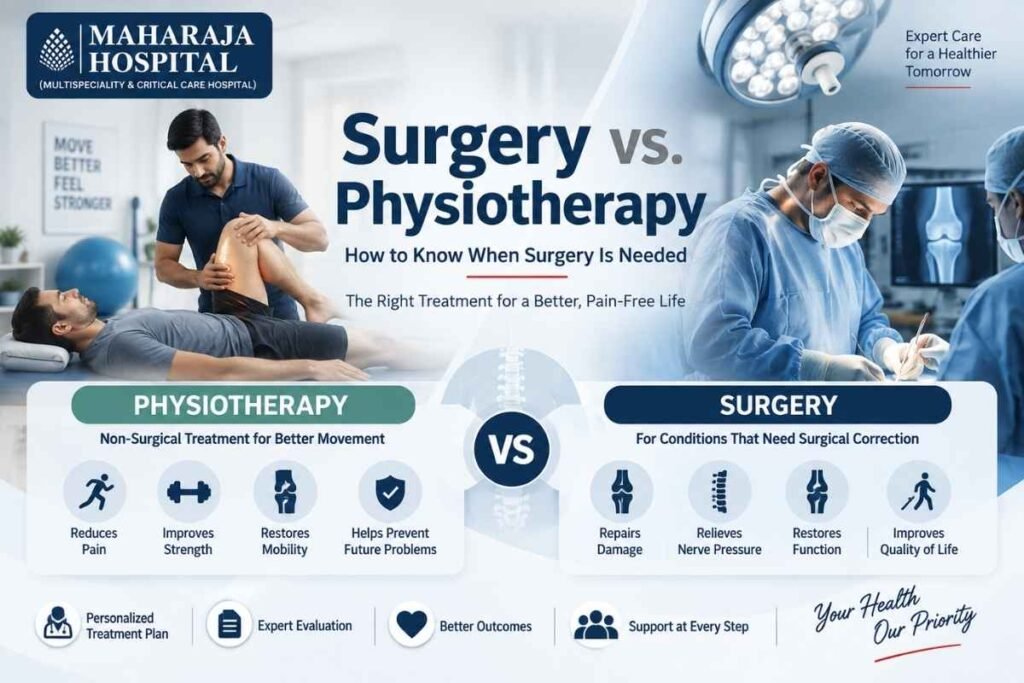
When you have persistent pain, limited movement, or difficulty performing everyday activities, one of the biggest questions is whether you need surgery or whether physiotherapy and other non-surgical treatments can help. The answer is not the same for everyone.
In many musculoskeletal conditions, physiotherapy, exercise, lifestyle changes, medicines, and other conservative treatments are considered before surgery. However, surgery may become appropriate when symptoms remain severe, a structural problem requires correction, or non-surgical treatment has not provided enough improvement. The decision should be based on the specific diagnosis, symptoms, examination findings, imaging, and overall health rather than pain alone.
For example, the World Health Organization recommends rehabilitation and other non-surgical approaches for many people with chronic primary low back pain, while specific structural problems may require specialist or surgical care.
What Is the Difference Between Physiotherapy and Surgery?
Physiotherapy focuses on improving movement, strength, flexibility, balance, and function without an operation. Depending on the condition, a physiotherapist may use therapeutic exercises, mobility training, manual techniques, posture education, and a structured rehabilitation programme.
Surgery, on the other hand, is used to correct or treat a physical problem that may not respond adequately to conservative treatment. This can include repairing damaged tissues, stabilising a joint, relieving pressure on a nerve, correcting a fracture, or replacing a severely damaged joint.
These treatments are not always alternatives. In many cases, physiotherapy is used before surgery to improve function and after surgery to support recovery.
When Is Physiotherapy Usually Tried First?
For many common musculoskeletal problems, starting with non-surgical treatment can be reasonable when there is no urgent structural or neurological problem.
Physiotherapy may be recommended for conditions such as:
- Muscle and soft-tissue injuries
- Some types of joint pain
- Mild to moderate back pain
- Neck pain
- Certain shoulder problems
- Some knee conditions
- Recovery after injury
- Weakness and reduced mobility
- Rehabilitation following surgery
For chronic primary low back pain, WHO recommends approaches such as education, exercise programmes, selected physical therapies, psychological therapies, and appropriate medicines as part of non-surgical care.
The purpose is not simply to reduce pain. A good rehabilitation programme should also help improve strength, movement, confidence, and the ability to return to normal activities.
How Long Should You Try Physiotherapy?
There is no universal number of weeks that applies to every condition.
The appropriate duration depends on the diagnosis, severity of symptoms, age, activity level, previous treatment, and response to rehabilitation. Some people improve relatively quickly, while others need a longer programme.
The important point is progress.
If your pain and function are gradually improving, continuing a properly supervised rehabilitation programme may make sense. However, if symptoms remain severe, function continues to decline, or new neurological symptoms develop, your treatment plan should be reassessed.
Simply continuing physiotherapy indefinitely despite worsening symptoms is not a good strategy.
When Might Surgery Be Necessary?
Surgery may be considered when there is a specific problem that needs surgical correction or when appropriate non-surgical treatment has failed to provide adequate improvement.
Some situations where surgery may be considered include:
1. Severe Joint Damage
Advanced arthritis can cause significant pain, stiffness, and difficulty walking or performing daily activities. When non-operative treatment no longer provides sufficient relief, joint replacement may be considered in appropriate patients.
For knee osteoarthritis, AAOS guidance notes that surgical treatment can be considered when non-operative treatments fail to provide adequate relief and pain continues to interfere with daily activities.
2. Certain Serious Injuries
Some fractures, ligament injuries, or other structural injuries may require surgery because the affected bone or tissue cannot heal properly with conservative treatment alone.
The type and severity of the injury determine whether immobilisation, physiotherapy, or surgery is appropriate.
3. Persistent Nerve Compression
Some spinal conditions can place pressure on nerves and cause pain, numbness, weakness, or other neurological symptoms. If significant nerve compression persists or neurological function is deteriorating, surgical assessment may be necessary.
4. Severe or Progressive Symptoms
Persistent symptoms that significantly affect walking, work, sleep, or basic daily activities may require a more detailed evaluation, particularly when they are not responding to appropriate conservative treatment.
5. Structural Problems That Cannot Be Corrected With Physiotherapy
Physiotherapy can improve muscle function and movement, but it cannot physically repair every structural problem.
For example, certain unstable injuries, advanced joint damage, or significant tissue tears may require a surgical procedure depending on the individual circumstances.
Signs That You May Need a Surgical Evaluation
Not every persistent pain problem requires surgery. However, you should discuss surgical options with a specialist when you experience:
- Persistent pain despite appropriate treatment
- Increasing difficulty walking or using a joint
- Significant loss of movement
- Progressive muscle weakness
- Persistent numbness or tingling
- Repeated joint instability
- A structural injury confirmed through imaging
- Severe arthritis affecting daily activities
- Symptoms that continue to worsen despite rehabilitation
The presence of one of these symptoms does not automatically mean surgery is required. It means that the underlying problem may need a more detailed evaluation.
When Is Surgery More Urgent?
Certain symptoms should not be managed by simply continuing physiotherapy.
For example, people with severe low back pain who develop new bladder or bowel problems, urinary retention, saddle-area numbness, or significant progressive weakness may have a serious neurological condition requiring urgent assessment.
Similarly, severe trauma, suspected fractures, infection symptoms, or rapidly worsening neurological problems may require urgent medical attention.
In these situations, delaying evaluation in the hope that physiotherapy will solve the problem can be unsafe.
Does Surgery Mean You No Longer Need Physiotherapy?
No.
Physiotherapy often remains an important part of treatment after surgery. Rehabilitation may help restore:
- Muscle strength
- Joint movement
- Balance
- Flexibility
- Walking ability
- Functional independence
The exact rehabilitation programme depends on the type of surgery and the patient’s condition.
For example, after joint replacement, physiotherapy can help the patient gradually regain movement and strength. After certain tendon or ligament procedures, rehabilitation is also important for protecting the repair while progressively restoring function.
Can Physiotherapy Prevent Surgery?
Sometimes, but not always.
If a condition responds well to rehabilitation, surgery may not be necessary. Physiotherapy can improve strength, mobility, posture, movement patterns, and physical function.
However, it is incorrect to assume that physiotherapy can prevent every surgery. Some structural problems require surgical correction regardless of how strong the surrounding muscles become.
The goal should therefore be the right treatment for the right diagnosis, rather than avoiding surgery at all costs.
How Do Doctors Decide Between Surgery and Physiotherapy?
The decision usually involves several factors rather than one symptom.
Your doctor may consider:
- The exact diagnosis
- Severity and duration of symptoms
- Physical examination findings
- X-rays, MRI, CT scans, or other investigations when appropriate
- Your response to previous treatment
- Your age and overall health
- Your activity and lifestyle requirements
- Potential benefits and risks of surgery
- Your personal treatment goals
This approach helps ensure that treatment is based on the actual cause of the problem rather than simply treating pain as a symptom.
When Should You Consult an Orthopedic Specialist?
If pain, stiffness, weakness, or restricted movement continues despite appropriate treatment, an evaluation by an Orthopedics surgeon in Rewari can help determine whether further conservative care or surgical treatment is appropriate.
An orthopedic specialist can assess the musculoskeletal problem, review relevant imaging, and explain the available treatment options.
If your condition involves a problem that requires evaluation beyond the musculoskeletal system, your treating doctor may also recommend consultation with a General surgeon in Rewari where appropriate.
Surgery vs. Physiotherapy: Which One Is Right for You?
There is no universal answer to whether surgery or physiotherapy is better. It depends on what is causing the problem.
For many conditions, conservative treatment may be an appropriate first step. For others, surgery may be necessary because of severe joint damage, structural instability, serious injury, or persistent nerve compression.
The key is not to choose a treatment based only on fear of surgery or the assumption that surgery is always the fastest solution. A proper diagnosis and discussion with a qualified specialist can help you understand the benefits, risks, alternatives, and expected recovery associated with each option.
Final Thoughts
Surgery and physiotherapy should not always be viewed as competing treatments. In many cases, they work together as part of a broader treatment plan.
Physiotherapy can help many patients improve strength, mobility, and function without surgery. At the same time, certain structural or progressive conditions may require surgical intervention when conservative treatment is insufficient or when delaying treatment could create additional problems.
If your symptoms are persistent, worsening, or interfering with daily life, getting an accurate diagnosis is the most important first step. From there, your healthcare team can determine whether continued physiotherapy, another non-surgical approach, surgery, or a combination of treatments is appropriate for your condition.