MIPH vs Traditional Haemorrhoidectomy: Differences, Benefits & Recovery Time

Understanding Knee Pain: Expert Insights by Maharaja Hospital
April 8, 2026
How to Manage Diabetes Naturally: Proven Ways to Control Blood Sugar Levels
April 14, 2026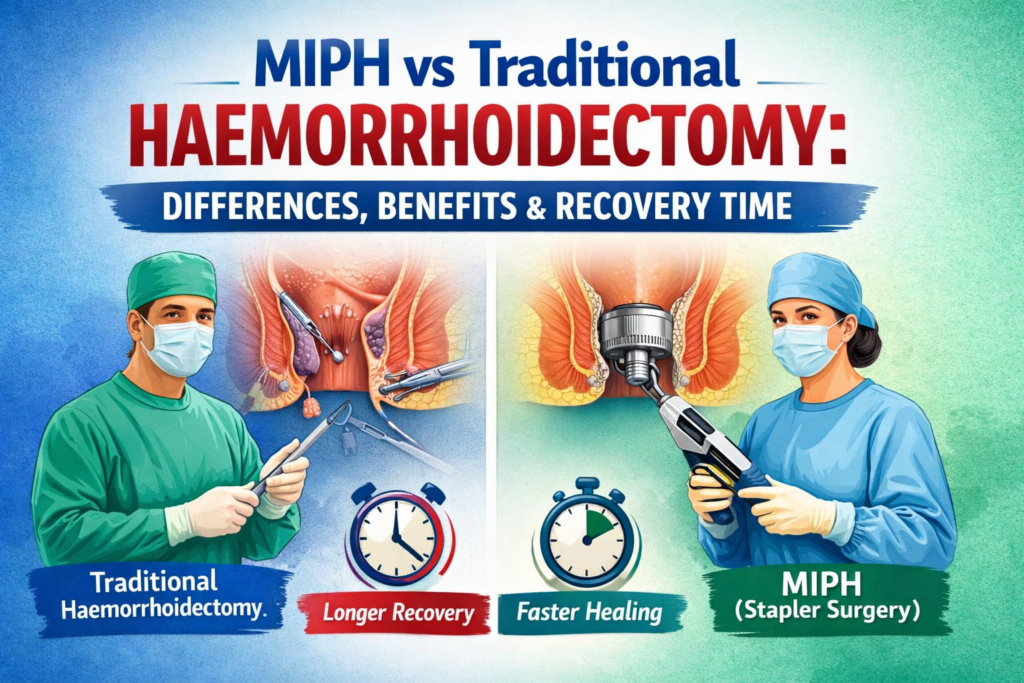
Dealing with piles (hemorrhoids) can be uncomfortable, painful, and honestly, frustrating to live with. When medications and lifestyle changes stop working, surgery becomes the next step. But then comes the real confusion — which surgery is better?
Two of the most commonly recommended procedures today are Traditional Haemorrhoidectomy and MIPH (Minimally Invasive Procedure for Hemorrhoids). Both aim to treat piles effectively, but they differ significantly in approach, recovery, and patient comfort.
If you’re trying to decide between the two, this guide breaks it down in a way that actually helps you make a clear decision.
Understanding the Basics of Piles Surgery
Before comparing the procedures, it’s important to understand why surgery is even needed.
Piles occur when veins in the rectal area become swollen due to pressure. In early stages, they can be managed with diet, medication, and lifestyle changes. But when symptoms like persistent bleeding, prolapse, or severe pain show up, surgical treatment becomes necessary.
At advanced stages, delaying surgery only worsens the condition and makes treatment more complicated.
What Is Traditional Haemorrhoidectomy?
Traditional haemorrhoidectomy is the older and more conventional surgical method used to remove piles.
In this procedure, the surgeon physically removes the swollen hemorrhoidal tissue using surgical instruments. It is typically recommended for severe or complicated cases, especially when piles are large or thrombosed.
Key Features:
- Complete removal of hemorrhoidal tissue
- Performed under anesthesia
- Suitable for advanced-grade piles
- Highly effective in preventing recurrence
The Reality:
This method works well, but it comes with a downside — post-surgery pain and longer recovery time. Since tissue is cut and removed, healing takes time and can be uncomfortable.
What Is MIPH (Stapler Surgery for Piles)?
MIPH, also known as stapler surgery, is a modern and minimally invasive alternative.
Instead of removing piles directly, this procedure uses a circular stapling device to reposition the hemorrhoidal tissue and cut off its blood supply. As a result, the piles shrink and eventually disappear.
Key Features:
- No external cuts
- Minimal pain compared to traditional surgery
- Faster recovery
- Shorter hospital stay
The Reality:
MIPH is designed for patient comfort. However, it is not always suitable for extremely large or complicated hemorrhoids.
MIPH vs Traditional Haemorrhoidectomy: The Real Comparison
Let’s break this down in practical terms — not theory.
1. Pain Level
- Traditional Haemorrhoidectomy: High post-operative pain due to open wounds
- MIPH: Significantly less pain
If pain tolerance is a concern, MIPH clearly has the edge.
2. Recovery Time
- Traditional: 2–4 weeks for full recovery
- MIPH: Usually 5–10 days
This is a big deal for working professionals or anyone who can’t afford long downtime.
3. Hospital Stay
- Traditional: May require longer hospitalization
- MIPH: Often same-day or short stay
4. Risk of Recurrence
- Traditional: Very low recurrence
- MIPH: Slightly higher compared to traditional
This is where traditional surgery still holds strong.
5. Suitability
- Traditional: Best for severe, complex piles
- MIPH: Ideal for moderate cases
Which Surgery Should You Choose?
Here’s the honest answer — there is no “one-size-fits-all.”
- If your condition is severe or complicated → Traditional Haemorrhoidectomy is more reliable
- If your piles are moderate and you want quicker recovery → MIPH is the better option
The decision should always be made after proper diagnosis by an experienced surgeon. Choosing blindly based on “less pain” can backfire if the condition is not suitable for MIPH.
Why Expert Consultation Matters
This is where most patients go wrong — they Google symptoms, pick a surgery, and then try to match it to their case.
That’s not how it works.
A qualified surgical team will evaluate:
- Grade of hemorrhoids
- Severity of symptoms
- Patient’s overall health
- Risk factors
At a trusted facility offering General Surgeries in rewari, the focus is not just on performing surgery, but on selecting the right procedure for long-term results.
The Role of Minimally Invasive Techniques
Modern surgical advancements have shifted the focus toward faster recovery and minimal discomfort. Procedures like MIPH fall under the broader category of Laparoscopic Surgeries in rewari, where techniques are designed to reduce trauma to the body.
However, minimally invasive doesn’t always mean better for every case. It simply means better when used appropriately.
Recovery Tips After Piles Surgery
No matter which procedure you choose, recovery plays a huge role in your final outcome.
Here’s what actually matters:
- Stay hydrated
- Follow a high-fiber diet
- Avoid straining during bowel movements
- Maintain hygiene in the affected area
- Follow your doctor’s instructions strictly
Ignoring these basics is one of the biggest reasons patients face complications after surgery.
When Should You Consider Surgery?
You shouldn’t rush into surgery — but you also shouldn’t delay it unnecessarily.
Consider surgery if you experience:
- Persistent bleeding
- Severe pain
- Prolapsed hemorrhoids
- No relief from medication
Delaying treatment often leads to more complex procedures later.
Choosing the Right Hospital in Rewari
Let’s be clear — the success of your surgery depends less on the method and more on the expertise behind it.
An experienced surgical team ensures:
- Accurate diagnosis
- Right procedure selection
- Safe and hygienic environment
- Proper post-operative care
If you’re looking for expert care, choosing an established Orthopedic Hospital in Rewari like Maharaja Hospital ensures access to advanced surgical support, experienced doctors, and patient-focused treatment.
Final Thoughts
MIPH and Traditional Haemorrhoidectomy both have their place in modern treatment.
- MIPH offers comfort, speed, and convenience
- Traditional surgery offers long-term reliability for severe cases
The smartest move is not choosing what sounds easier — it’s choosing what is medically right for your condition.
If you’re dealing with piles and unsure about the next step, don’t guess. Get evaluated, understand your options clearly, and make a decision that actually solves the problem — not just delays it.