Revision Knee Replacement Surgery: Warning Signs, Common Causes, and When to See a Doctor

Robotic Knee Replacement Surgery: Common Myths, Medical Facts, and What Patients Should Know
October 19, 2026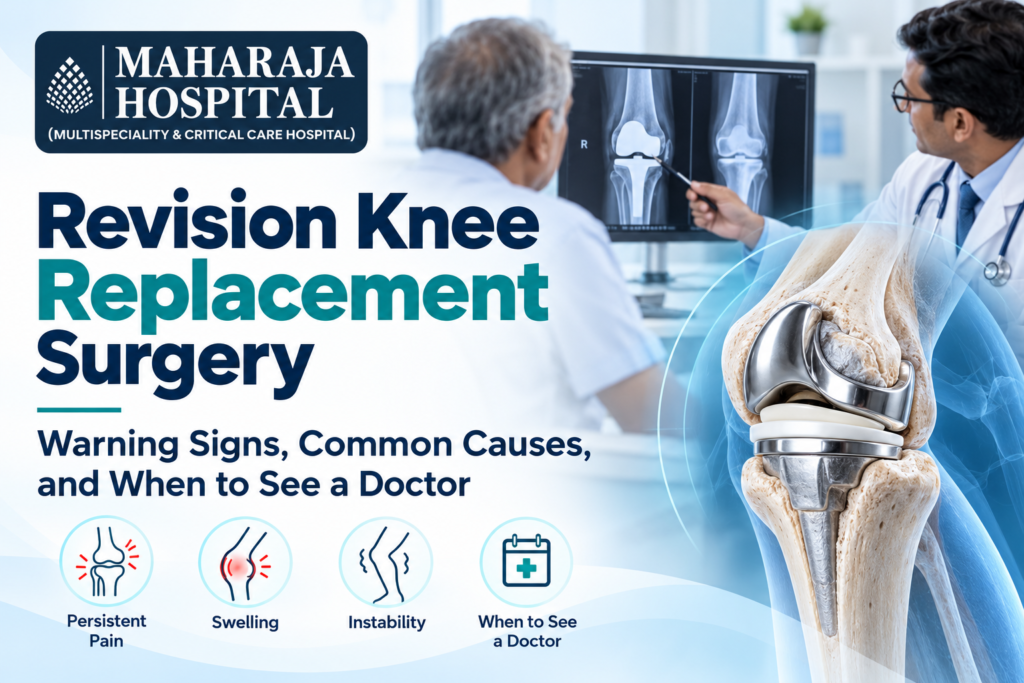
Knee replacement surgery is intended to relieve chronic joint pain, improve mobility, and help patients return to everyday activities. Most knee replacements function successfully for many years. However, some patients develop complications that affect the artificial joint, sometimes requiring another operation.
Revision knee replacement surgery becomes necessary when components of an existing knee implant become loose, worn, infected, unstable, or damaged. These problems can develop shortly after the original operation or many years later.
An important concern for patients is understanding whether discomfort after knee replacement is part of normal recovery or an early sign of implant failure. Recognising changes in pain, movement, swelling, and joint stability can help patients seek appropriate medical attention before complications worsen.
What Is Revision Knee Replacement Surgery?
Revision knee replacement is a procedure performed to repair or replace some or all components of an existing artificial knee joint.
During the original total knee replacement, damaged joint surfaces are replaced with artificial components, typically made from metal and medical-grade plastic.
If these components stop functioning properly, an orthopaedic surgeon may recommend revision surgery to address the underlying problem.
Depending on the condition of the implant and surrounding bone, the procedure may involve replacing a single component or reconstructing the entire artificial joint.
Revision surgery is generally more complex than primary knee replacement because surgeons must evaluate existing implants, bone loss, scar tissue, and surrounding ligaments.
Warning Signs That May Indicate Knee Replacement Failure
Not every episode of pain after knee replacement indicates implant failure. However, certain symptoms require careful assessment.
1. Persistent or Increasing Knee Pain
Some discomfort is expected during the initial recovery period. Pain should generally improve as healing and rehabilitation progress.
However, pain that continues to worsen, returns after a period of comfortable movement, or develops several years after surgery may indicate an underlying problem.
Pain caused by implant loosening often increases during weight-bearing activities, while infection-related pain may occur even at rest.
2. Repeated Swelling Around the Knee
Temporary swelling is common after surgery, particularly during early rehabilitation.
However, persistent or recurring swelling long after recovery may indicate inflammation, instability, infection, or another complication.
Swelling accompanied by redness, warmth, or increasing discomfort requires prompt evaluation.
3. Knee Instability or Giving Way
A properly functioning artificial knee should provide sufficient stability during normal daily activities.
If the knee repeatedly buckles, shifts unexpectedly, or feels unreliable while walking, the surrounding ligaments or implant components may not be functioning correctly.
Instability can increase the risk of falls and may require treatment.
4. Increasing Stiffness and Restricted Movement
Difficulty bending or straightening the knee may develop when excessive scar tissue forms around the joint.
Other possible causes include implant positioning problems or mechanical complications.
A noticeable reduction in movement, particularly after previously achieving satisfactory mobility, should be investigated.
5. Changes in Knee Alignment or Visible Deformity
A noticeable change in leg alignment, unusual knee positioning, or newly developed deformity may indicate implant movement, instability, or bone-related complications.
These changes require orthopaedic examination rather than attempting to correct them through unsupervised exercises.
Common Causes of Revision Knee Replacement
Understanding why artificial knee joints sometimes fail helps explain when revision surgery may become necessary.
Implant Loosening
Knee replacement components must remain securely attached to the surrounding bone.
Over time, the connection between an implant and the bone can weaken. This is known as aseptic loosening when no infection is involved.
Patients may experience increasing pain while standing, walking, or climbing stairs.
Loosening can be associated with implant wear, bone loss, mechanical forces, or other factors.
Infection Around the Artificial Joint
Periprosthetic joint infection is a serious complication that may develop soon after surgery or years later.
Bacteria can attach to artificial joint surfaces and surrounding tissues, making infection difficult to eliminate.
Possible symptoms include persistent pain, swelling, redness, or wound drainage. Fever is not always present.
Treatment depends on the infection’s severity and duration. Some cases require surgical cleaning, while others require implant removal and replacement.
Wear of Implant Components
Artificial knee implants contain components designed to move against one another.
Over years of use, the plastic bearing surface may gradually wear down.
Wear particles can sometimes contribute to bone loss around the implant, a condition known as osteolysis.
Significant wear or associated loosening may eventually require revision surgery.
Ligament Problems and Joint Instability
The stability of a replaced knee depends partly on the surrounding ligaments and soft tissues.
Ligament damage or imbalance may cause abnormal joint movement, repeated swelling, and difficulty walking.
When appropriate physiotherapy or bracing cannot adequately control instability, surgical revision may be considered.
Fractures Around the Knee Implant
A fracture occurring near an artificial knee is called a periprosthetic fracture.
Such fractures may follow a fall or injury, particularly in patients with weakened bones.
Treatment depends on the fracture location, bone quality, and whether the existing implant remains stable.
Some fractures can be repaired while retaining the implant; others require revision surgery.
How Do Doctors Diagnose Knee Replacement Failure?
Determining the cause of pain after knee replacement requires more than identifying symptoms.
An orthopaedic specialist usually begins by reviewing the original surgery, recovery history, symptom progression, and previous medical records.
Physical examination helps assess knee movement, swelling, tenderness, stability, and alignment.
Depending on the suspected problem, diagnostic investigations may include:
- X-rays: To assess implant positioning, bone changes, fractures, and possible loosening.
- CT scans: To examine component positioning or bone structure when additional detail is required.
- Blood tests: Tests such as ESR and CRP may help identify inflammation or possible infection.
- Joint aspiration: Fluid may be collected from the knee to investigate suspected infection.
- Other imaging: Selected patients may require additional investigations when the cause remains unclear.
These findings help determine whether the symptoms originate from the artificial joint or another condition.
Does Every Painful Knee Replacement Require Revision Surgery?
No. Persistent pain does not automatically mean another knee replacement is necessary.
Some patients experience discomfort because of muscle weakness, rehabilitation difficulties, tendon problems, or conditions affecting other parts of the body.
Depending on the diagnosis, nonsurgical treatment may include physiotherapy, activity modification, suitable medication, or bracing.
For this reason, identifying the actual cause of pain is essential before considering another operation.
Revision surgery is generally recommended when a significant mechanical problem, infection, or another complication cannot be adequately managed through appropriate alternative treatment.
When Should You Consult an Orthopaedic Doctor?
Patients should arrange an orthopaedic assessment if they experience persistent or worsening knee pain, recurring swelling, increasing stiffness, or difficulty walking after knee replacement.
A previously comfortable artificial knee that suddenly becomes painful also deserves medical attention.
People seeking an evaluation at an Orthopedic Hospital in Rewari can discuss their symptoms, previous surgical history, diagnostic findings, and available treatment options with an orthopaedic specialist.
Seek urgent medical attention for a suddenly hot and swollen knee, wound drainage, fever with worsening joint symptoms, or severe pain following a fall.
Sudden breathlessness or chest pain following recent surgery requires emergency medical care because it may indicate a blood clot in the lungs.
What Happens During Revision Knee Replacement Surgery?
The surgical approach depends on the reason for implant failure.
The surgeon may remove loose or damaged components, assess the surrounding bone, and prepare the joint for replacement components.
Specialised implants may be necessary when substantial bone loss or ligament instability is present.
In cases involving infection, surgery may be performed in stages to help eliminate the infection before a new permanent implant is inserted.
Because revision procedures can involve additional reconstruction, they generally require more extensive planning than primary knee replacement.
Recovery After Revision Knee Replacement
Recovery varies according to the complexity of surgery, existing bone condition, muscle strength, and overall health.
Physiotherapy usually focuses on restoring movement, strengthening surrounding muscles, and improving walking ability.
Some patients may require walking aids for an extended period, particularly after complex reconstruction.
Follow-up examinations help monitor implant stability, wound healing, and rehabilitation progress.
Revision surgery also carries potential risks, including infection, stiffness, blood clots, and further implant-related complications. These should be discussed before treatment.
Conclusion
Revision knee replacement surgery may be necessary when an existing artificial knee develops loosening, infection, instability, significant wear, or other structural complications.
Persistent pain, recurring swelling, reduced mobility, and changes in joint stability are important warning signs, but they do not automatically indicate implant failure.
A thorough medical assessment is essential to distinguish normal postoperative discomfort from conditions requiring treatment.
Recognising concerning symptoms and consulting an orthopaedic specialist at the appropriate time can help patients understand their options and make informed decisions about protecting long-term knee function.